Mrs Ferrars’s confession to Roger Ackroyd
The Murder of Roger AckroydMrs Ferrars’s confession to Roger Ackroyd is the disclosure that turns private grief into a question of murder, blackmail, and duty. She admits that she poisoned Ashley Ferrars; her account also implicates an unnamed blackmailer and places Ackroyd in a position of painful knowledge. The scene matters both for what it reveals and for how it is narrated: Sheppard presents himself as Ackroyd’s confidant, but the manuscript’s ending recasts his account as a carefully managed concealment.
Background and Disclosure
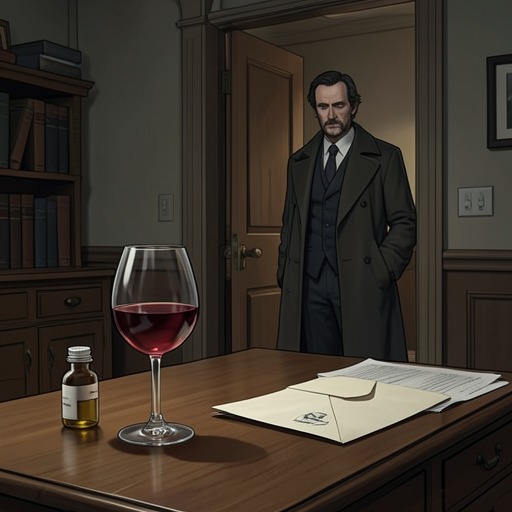
Ackroyd begins by asking Sheppard whether he attended Ashley Ferrars during his last illness. The question surprises the doctor, who has just explained that idle talk from his sister first prompted his suspicions. Ackroyd then states that Ashley was poisoned and identifies his wife as the poisoner, explaining that she told him herself.
The confession had come the previous day, after a long-delayed conversation about Ackroyd and Mrs Ferrars’s engagement. He had proposed to her three months earlier; after initially refusing, she agreed to marry him but would not allow the engagement to be made public until her year of mourning was over. Ackroyd told her that a year and three weeks had passed since her husband’s death and that there was no longer an objection to announcing their engagement. She had seemed unsettled for several days, and then broke down and revealed her hatred of her husband, her growing love for Ackroyd, and her use of poison to kill him.
For Ackroyd, the revelation is not simply an admission by the woman he intends to marry. Sheppard describes him as horrified by the murder and fundamentally committed to law and civic duty. Ackroyd understands that her disclosure has made him an accessory after the fact: knowledge now obliges him to consider what he ought to do, even as he struggles with the emotional shock of learning what she has done.
Blackmail and the Twenty-Four-Hour Promise
Mrs Ferrars’s confession also reveals that another person had known of the poisoning all along and had been blackmailing her for large sums. Ackroyd believes that the sustained pressure had nearly driven her mad, but she refuses to give him the blackmailer’s name. The hidden identity becomes an additional secret within the scene, and Ackroyd suspects that the person may be among his own household, though he cannot bring himself to treat that suspicion as certain.
Stunned by the confession, Ackroyd did not immediately decide how to act. Mrs Ferrars asked him to promise that he would do nothing for twenty-four hours, and she said he would hear from her before that period ended. She subsequently died by suicide. Ackroyd says that he never understood what she meant to do and blames himself for having driven her to it; Sheppard tries to dissuade him from taking responsibility for her death. The promise and its deadline thus acquire a tragic consequence: the time she asked him to wait becomes inseparable from the death he did not anticipate.
The Letter and the Unread Disclosure
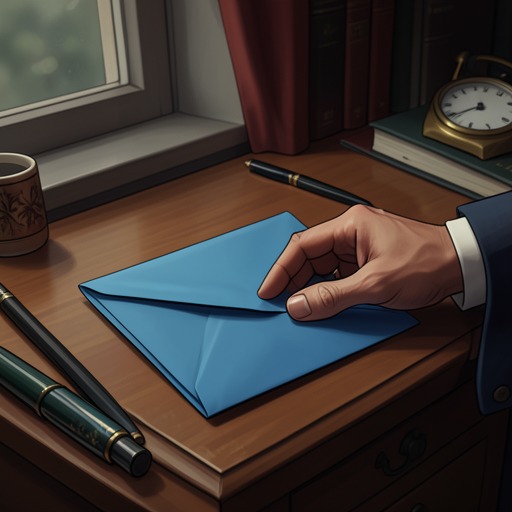
Ackroyd tells Sheppard that a letter has arrived, but Sheppard cannot persuade him to read even the name of the man who has been blackmailing Mrs Ferrars. Ackroyd’s resistance leaves the identity unresolved at the moment when Sheppard is with him. The doctor later records that he left at just before nine, with the letter still unread, after pausing at the door to consider whether he had left anything undone.
That precise account becomes important when the manuscript’s ending revisits the scene. Sheppard admits that he feared Mrs Ferrars had told Ackroyd everything before her death, and that Ackroyd’s agitation made him wonder whether his friend knew the truth. He describes taking precautions and using the Dictaphone Ackroyd had lent him to adjust. Recalling the published account of his departure, Sheppard notes that its statements were literally true, but says he could have inserted a row of stars after the letter’s arrival to conceal what happened during the intervening ten minutes. The careful truth of the account therefore becomes a means of withholding the decisive action, not proof that the narration is complete.
Narrative Function and Reinterpretation
Sheppard initially presents the confession as a confidant’s disclosure: Ackroyd tells him the story in confidence because he cannot bear its weight alone and wants his advice. The account gives the reader a clear chain of information—Ashley’s poisoning, Mrs Ferrars’s admission, the blackmail, the promised delay, and her death—while leaving the blackmailer unnamed. It also places Sheppard at the center of the exchange, apparently as a trusted doctor and friend.
The later framing undermines that apparent transparency. Sheppard’s manuscript says that he finished writing at five in the morning, exhausted, and had once imagined publishing it as the history of one of Hercule Poirot’s failures. In the final account, he acknowledges that his seemingly exact description of leaving Ackroyd leaves a blank in which his actions were hidden. The confession is therefore a double hinge: within the story it gives Ackroyd knowledge that raises a question of duty; within the retrospective manuscript it helps explain Sheppard’s fear and reveals the method by which he manipulated the reader’s access to events. The narrative does not merely disclose secrets through testimony; it makes the completeness and reliability of testimony part of the mystery.